Tute
2. Overview
What is an MVP?
We explore what Is a minimal viable product (MVP) and what it definitely isn’t.

Allie Walters
Founder of Unstuck, Brand Meadow & Senior Product Designer
It's a learning tool
I used to think MVP meant “a bad version of the final thing.”
It doesn’t. And believing that almost stopped me from shipping anything for years.
An MVP, or Minimum Viable Product, is not a half-baked app, a broken website, or something you apologise for when you show it to people. It’s a learning tool. That’s it. The fastest, cheapest way to test whether your idea solves a real problem for a real person.
The mistake I see over and over again is people confusing “minimum” with “lazy” or “viable” with “perfect.” I’ve done it myself. I once spent weeks polishing UI details on a product that no one actually needed. Clean typography. Smooth transitions. Zero users. Painful lesson.
A real MVP answers one core question:
“If I put this in front of someone, will it help them do the thing they’re struggling with right now?”
That’s the bar. Not branding. Not scale. Not features.
An MVP is:
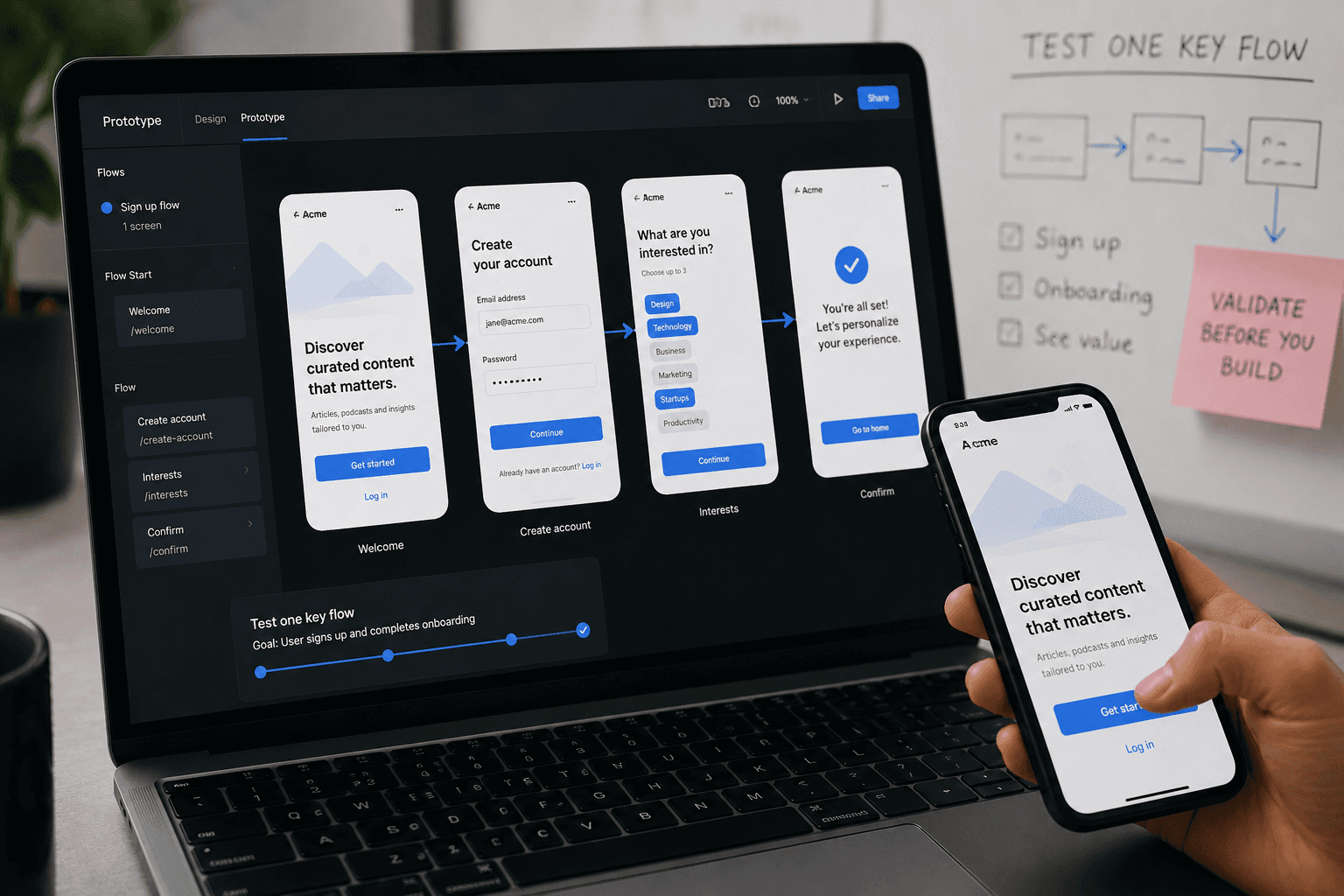
A clickable prototype that tests one key flow
A landing page with a clear value proposition
A no-code tool that solves one painful step
A scrappy workaround that people actually use
An MVP is not:
A full product roadmap
Every feature you’ve ever imagined
A polished UI system
Something you spend six months building in isolation
The biggest mindset shift is this: your MVP exists to be wrong as fast as possible. That sounds harsh, but it’s freeing. If it’s wrong, you learn. If it’s right, you double down. Either way, you move.
When I build MVPs now, I deliberately leave things unfinished. I don’t add edge cases. I don’t future-proof. I focus on the one moment of value. The moment where the user goes, “Oh… this helps.”
No-code tools make this even more powerful. You can build an MVP in Figma, Framer, Webflow, or even a Google Form if that’s what gets the insight. The tool doesn’t matter. The learning does.
If you’re stuck, ask yourself this:
What’s the smallest thing I could build to test this idea?
What would I remove if I had to ship this in a week?
What am I secretly polishing to avoid showing it to users?
That last one stings. But it’s usually the truth.
“If I put this in front of someone, will it help them do the thing they’re struggling with right now?”