Tute
4. Minimum
What is minimum
Minimum doesn’t mean small for the sake of it. It means focused. We explore what Decide What “Minimum” really means (without cutting the wrong stuff).

Allie Walters
Founder of Unstuck, Brand Meadow & Senior Product Designer
Make your MVP "user-full."
This is where most MVPs quietly fall apart.
People say they’re building something “minimal,” but what they usually mean is “unfinished in random places.” I’ve done this. I’ve shipped MVPs that technically worked but completely missed the point because I cut the wrong things.
Minimum doesn’t mean small for the sake of it.
It means focused.
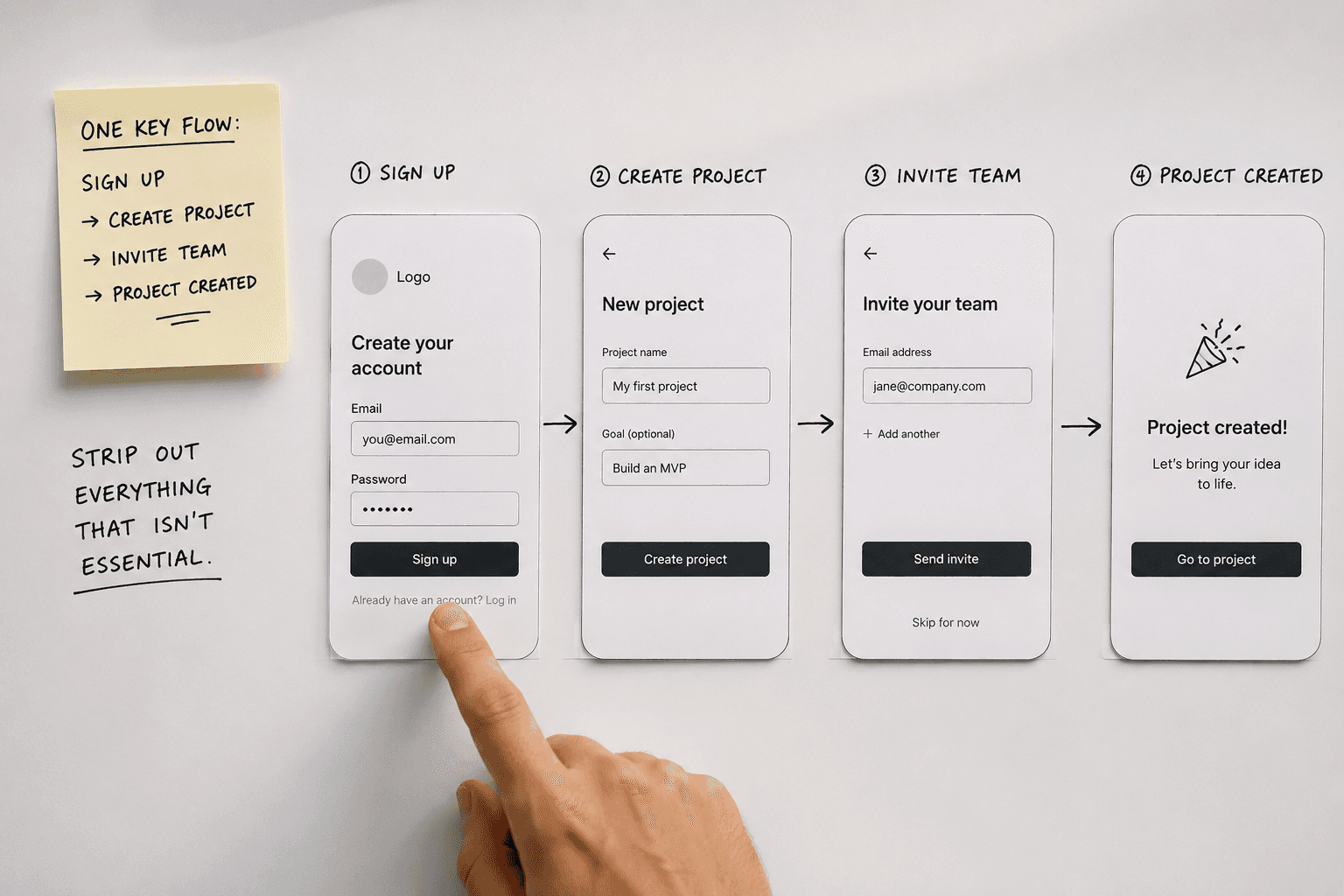
The way I decide what’s truly “minimum” now is brutal but effective. I start by asking: what is the one action that proves this idea is useful? Not nice. Not impressive. Useful.
If your product disappeared tomorrow, what would your user miss most? That’s usually your core.
For example:
If you’re building a booking tool, the core is booking — not profiles, not reminders, not dashboards.
If you’re building a learning product, the core might be one transformation, not the entire curriculum.
If you’re building a productivity tool, it’s probably one workflow, not ten.
Everything else is optional until proven otherwise.
I often write a list of everything I want to build, then cross out anything that doesn’t directly support that one action. It’s uncomfortable. It feels like throwing away good ideas. But those ideas aren’t gone — they’re parked.
A mistake I see all the time is people cutting the boring stuff instead of the unnecessary stuff. They’ll keep animations and remove onboarding. Or keep filters and remove clear copy. That’s backwards.
When deciding what to cut, ask:
Does this help the user succeed faster?
Does this reduce confusion or friction?
Does this directly support the core action?
If the answer is no, it’s not MVP material yet.
Another thing I’ve learned is that “minimum” changes depending on who you’re testing with. An MVP for early adopters can be rougher than one you’re showing to a client or investor. Context matters. But clarity always wins.
I also time-box aggressively. If I can’t build the first version in a few days (or even hours, using no-code), it’s too big. That constraint forces better decisions.
The goal isn’t to ship something tiny. The goal is to ship something testable. If your MVP lets you learn one important thing about your user, it’s done. You can iterate from there.
"Minimum doesn’t mean small for the sake of it. It means focused. The goal isn’t to ship something tiny.
The goal is to ship something testable."